
The Rise of Fractional HR: Why Smart Businesses in Singapore and Beyond Are Rethinking People Leadership
There is a quiet revolution happening in the way businesses access HR leadership and it is accelerating faster than most founders and business leaders realise.
Across the world, and right here in Singapore, companies are moving away from the assumption that senior HR expertise must come packaged as a full-time hire with a full-time price tag. In its place, a more agile, outcome-driven model is gaining serious traction: fractional HR.
Whether you are a founder scaling your first team in Singapore, an SME expanding across Southeast Asia, or a global company establishing regional headquarters in APAC, understanding this shift could fundamentally change how you build your people function and how quickly you grow.
What Is Fractional HR — And Why Is It Different?
Fractional HR is not a consultant who parachutes in to write a report and disappear. Nor is it a part-time administrator handling paperwork. A fractional HR leader is an experienced, senior-level HR professional — the equivalent of a Head of HR, HR Director, or Chief People Officer — who works with your business on a structured, ongoing basis, typically one to three days per week.
They sit at your leadership table. They own both strategy and execution. They are accountable for results. The only difference from a full-time hire is that you access their expertise at a fraction of the cost, with the flexibility to scale that engagement up or down as your business evolves.
For growing businesses, this distinction matters enormously. Most companies at the startup or SME stage do not need a full-time CHRO working five days a week. But they absolutely need the *thinking* of one.
The Global Numbers Tell a Clear Story
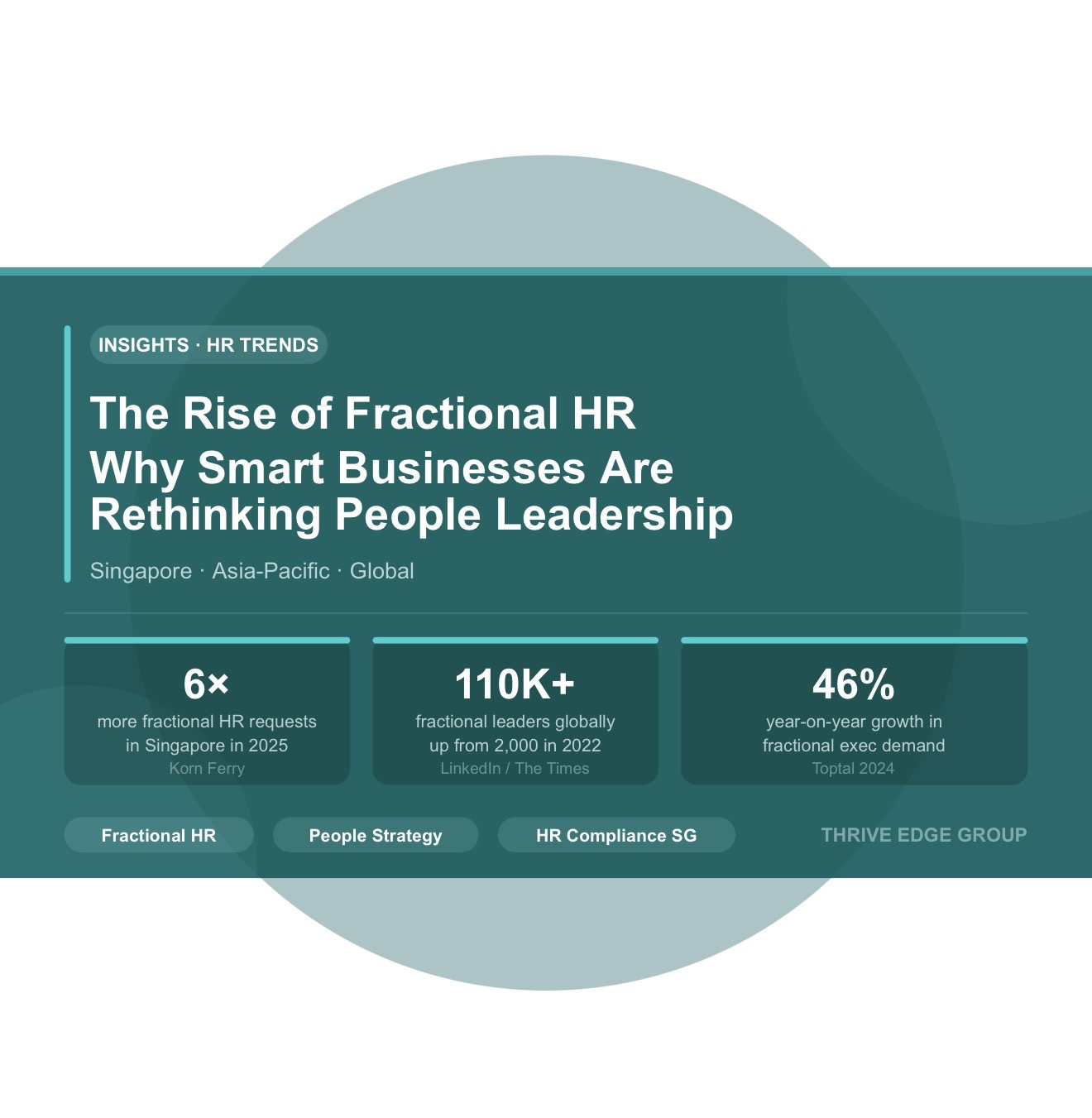
The data on fractional leadership is striking. LinkedIn profiles carrying the “fractional” title surged from approximately 2,000 in 2022 to around 110,000 by early 2024 — a 55-fold increase in just two years. The global fractional executive market has surpassed $5.7 billion and is growing at roughly 14% annually.
Demand for fractional executives grew by 46% year-over-year** according to a 2024 Toptal survey, with particularly strong uptake in the United States, the United Kingdom, Latin America — and Southeast Asia. Globally, over 120,000 fractional leaders are now working across multiple companies simultaneously, double the count from 2022.
Harvard Business Review has dedicated significant coverage to the model. As Amy Bonsall, a fractional Chief Product Officer who co-authored the HBR article “How Part-Time Senior Leaders Can Help Your Business”, put it: fractional leadership allows senior professionals to combine the strategic ownership of an in-house leader with the cross-industry insight of a consultant, giving both the executive and the businesses they serve something neither a pure consulting relationship nor a full-time role typically delivers on its own.
Gartner forecasts that by 2027, over 30% of mid-sized enterprises globally will have at least one fractional executive on retainer. The question for Singapore businesses is not whether this model is relevant. The question is whether you are positioned to take advantage of it.
Why Fractional HR Is Growing: The Real Drivers
The rise of fractional HR is not simply a cost-cutting story. It reflects deeper shifts in how businesses grow, how leadership needs evolve, and how organisations think about risk.
1. Scaling speed has outpaced traditional hiring
Companies today particularly startups and SMEs scaling across Singapore and APAC move faster than traditional hiring can support. A search for a senior HR Director can take three to six months and cost tens of thousands of dollars in recruitment fees alone. A fractional HR engagement can be operational within days.
For a business navigating rapid headcount growth, entering a new market, managing an employee relations issue, or preparing for investment, that speed is often decisive.
2. HR compliance has grown significantly more complex
For businesses operating in Singapore, employment compliance is not optional — and the cost of getting it wrong is high. From the Employment Act and CPF regulations to MOM work pass requirements, fair employment guidelines (TAFEP), and data protection obligations under the PDPA, the regulatory landscape is sophisticated and continuously evolving.
According to research from the US Chamber of Commerce, around 51% of small businesses globally say compliance requirements make it harder to grow, and 47% spend too much time fulfilling them. In Singapore’s business environment which combines high regulatory rigour with genuine enforcement — this challenge is even more acute for companies without dedicated HR leadership.
A fractional HR consultant with deep Singapore compliance experience can build the right frameworks from day one, significantly reducing legal and reputational risk.
3. Not every business needs full-time HR — but every business needs good HR
This is perhaps the most important insight behind the fractional model. Growing businesses often face a false choice: hire a junior HR executive they can afford but who lacks the experience to lead strategy, or wait until they can justify a senior hire and hope nothing goes wrong in the meantime.
Fractional HR eliminates that choice. As award-winning fractional HR professional Barry Flack described it in a Frazer Jones interview, the fractional model means clients get “on-demand access to senior HR support without having to hire a full-time Head of People that they likely can’t afford — and frankly might not even need full-time at this stage.”
Singapore: A Market Primed for Fractional HR Leadership
Singapore’s unique position as a global business hub makes it particularly well-suited to the fractional HR model — and the local data confirms that adoption is accelerating rapidly.
Korn Ferry reported a six-fold increase in requests from Singapore-based firms for fractional leaders in 2025 compared to the previous year. Hiring platform ConnectOne saw the number of positions open to fractional hires triple in 2025, with demand coming predominantly from startups and SMEs.
PwC Singapore, in a piece published in *The Business Times* in March 2025, noted that demographic shifts, talent shortages, and rising cost pressures are driving organisations in Singapore to “rethink traditional employment models” — with fractional and portfolio employment emerging as a key part of that rethinking. PwC described the model as a way to “enhance workforce participation” and “strengthen Singapore’s labour market resilience.”
The reasons are not hard to identify. Singapore hosts Asia-Pacific headquarters for hundreds of multinational corporations alongside a fast-growing ecosystem of startups across fintech, healthtech, deep tech, and sustainability. Many of these businesses need serious HR capability — compliance frameworks, people strategy, talent architecture — but are not yet at the stage where a full-time Chief People Officer makes financial or operational sense.
For global companies establishing their first APAC presence in Singapore, engaging a fractional HR leader with deep regional and local expertise delivers immediate compliance coverage, cultural fluency, and the HR architecture needed for sustainable growth without the cost and risk of a full senior hire on day one.
A 2025 Hays Asia survey found that 57% of professionals in Singapore planned to change jobs that year, and 58% of workers observed a rise in individuals holding multiple roles. The appetite for flexible, high-quality work arrangements on both sides of the employment equation has never been higher.
What Fractional HR Looks Like in Practice
The scope of a fractional HR engagement depends entirely on the business’s stage and needs. In practice, it typically falls into three areas:
Building the foundation.
For companies setting up in Singapore or formalising their HR structure, this means employment contracts, employee handbooks, HR policies, onboarding processes, and statutory compliance — done properly, from the start. Getting this right early saves significant time, money, and legal exposure down the line.
Strategic people leadership
This is where fractional HR delivers its highest value for growing businesses. Workforce planning, organisational design, performance management frameworks, leadership development, succession planning, and compensation benchmarking — the kind of strategic thinking that shapes whether a company can attract, retain, and develop the talent it needs to scale.
Ongoing operational support
As an embedded member of your leadership team, a fractional HR consultant handles the day-to-day people questions that arise in any growing business such as employee relations, performance conversations, restructuring decisions, and everything in between. They are available when you need them, without the overhead when you do not.
Is Fractional HR Right for Your Business?
The fractional HR model tends to work particularly well for:
- Startups and scale-ups in Singapore that are building their first people function and need strategic leadership, not just administrative support
2. SMEs expanding regionally across Southeast Asia who need HR expertise that spans both Singapore compliance and broader APAC market knowledge
3. Global companies entering Singapore who need to set up compliant, scalable HR operations as part of their regional headquarters establishment.
4. Businesses in transition covering a senior HR departure, preparing for investment or acquisition, or navigating a significant restructure
The common thread is this: companies that need enterprise-level HR thinking, but are not yet at the stage or do not have the budget to justify a full-time senior hire.
The Future of HR Leadership Is Already Here
The fractional HR model is not a trend to watch cautiously from the sidelines. It is a structural shift in how businesses access senior people leadership — one that is already well underway, both globally and here in Singapore.
The businesses that move earliest tend to benefit most. They build the right people foundations before problems compound. They attract better talent because their HR architecture signals professionalism and care. And they scale more sustainably because their growth is built on compliant, thoughtful people strategy rather than reactive firefighting.
For founders and business leaders in Singapore considering this model, the question worth sitting with is simple: what would your business look like if you had access to genuinely senior HR leadership, starting now?